Industrial Engineering · Storage Tanks · Emission Control
Tank Seals for Industrial Storage: Types, Emission Control and Selection Guide
Industrial storage tanks play an essential role in the petroleum, petrochemical and chemical industries. Their performance depends not only on structural integrity and storage capacity but also on the systems used to control evaporation, protect stored products and maintain operational efficiency.
Among these components, tank seals are particularly important in floating roof storage tanks. They help close the gap between the floating roof and the tank shell, limiting the escape of vapors as the roof moves with the liquid level.
Selecting the right sealing technology requires an understanding of tank configuration, stored product characteristics, material compatibility and applicable technical requirements. For terminal operators and engineering teams, this decision can have significant implications for emissions management, maintenance and long-term equipment reliability.
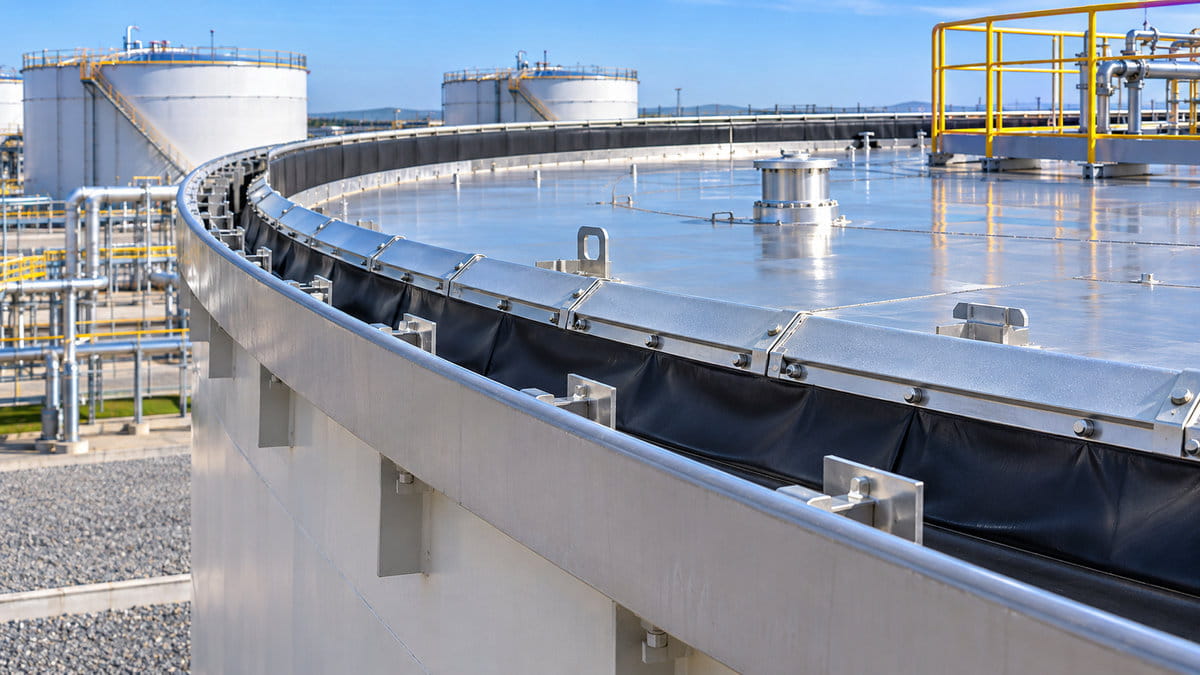
What are tank seals and why are they important?
Tank seals are engineered components used to limit vapor losses from industrial storage tanks. In floating roof tanks, primary and secondary rim seals close the gap between the roof perimeter and the tank shell while allowing normal roof movement.
Mechanical shoe seals, resilient-filled seals, flexible wipers and compression plate systems offer different sealing arrangements. Correct selection depends on the stored product, tank geometry, material compatibility, operating conditions and applicable technical requirements.
What Are Tank Seals and How Do They Work?
Tank seals are engineered components that close gaps in industrial storage tank systems to limit vapor escape, reduce product evaporation and protect stored liquids.
In floating roof tanks, the most important sealing arrangement is commonly known as the rim seal system.
A floating roof moves vertically as the level of the stored liquid changes. Because clearance is required between the roof perimeter and the cylindrical tank wall, a space remains around the roof edge.
This space is called the annular rim space.
A floating roof seal bridges this gap while allowing the roof to travel during filling and emptying operations.
Why Floating Roof Tanks Need Sealing Systems
Floating roofs reduce the vapor space above stored liquids compared with conventional fixed-roof arrangements.
However, potential vapor losses remain around the roof perimeter, deck fittings and, in certain roof designs, deck seams.
According to the US Environmental Protection Agency's AP-42 guidance on organic liquid storage tanks, rim seal losses are a relevant component of floating roof tank emissions.
Key Functions of Industrial Tank Seals
- Limiting the escape of volatile organic compounds (VOCs).
- Reducing evaporation-related product losses.
- Supporting compliance with applicable environmental requirements.
- Maintaining contact between the roof perimeter and tank wall.
- Protecting equipment performance throughout normal roof movement.
The actual level of emissions control depends on the tank configuration, operating conditions, seal design and condition of the equipment.
Primary and Secondary Tank Seals: What Is the Difference?
Floating roof sealing systems may use one or more sealing elements.
The two main categories are primary and secondary seals, although additional configurations can be adopted for particular applications.
Primary Tank Seals
The primary seal forms the main barrier between the floating roof edge and the tank shell. Its design must accommodate roof movement and variations in rim clearance.
Secondary Tank Seals
Secondary seals provide an additional barrier above the primary seal, helping to further limit vapor movement through the annular rim space.
Primary Tank Seals
The primary seal forms the main closure between the floating roof edge and the tank shell.
Its design must accommodate the movement of the roof and variations in the clearance between the floating deck and tank wall.
Common primary seal technologies include:
- Mechanical shoe seals: metallic plates maintain contact with the tank shell, together with a flexible vapor barrier connecting the assembly to the floating deck.
- Resilient-filled seals: flexible or filled elements are designed to maintain contact with the tank wall.
- Flexible wiper seals: flexible sealing elements contact the shell as the roof rises and falls.
The suitability of each system depends on the tank design, operating conditions and relevant specifications.
Secondary Tank Seals
Secondary seals provide an additional sealing barrier above the primary seal.
They are designed to further limit vapor movement through the rim space and, depending on the configuration, offer additional protection from environmental exposure.
Secondary seals may incorporate flexible wipers, metallic compression plates and specially selected vapor-barrier materials.
In certain regulated applications, a secondary seal is required alongside a specified primary seal.
However, the exact requirements depend on the applicable jurisdiction, tank type and environmental regulations.
Compression Plate Seals
A compression plate seal uses metallic components to maintain pressure against the tank shell and support a flexible sealing element.
This configuration can accommodate movement while limiting vapor passage through the roof perimeter.
Compression plate systems are frequently considered for external floating roof tanks.
Their engineering design must account for factors such as shell irregularities, plate flexibility, material compatibility and maintenance access.
External Floating Roof Seals: Engineering Requirements
External floating roof tanks have a roof directly exposed to atmospheric conditions.
Wind, rain, sunlight and changes in temperature can influence the operating environment of their sealing systems.
For this reason, the design of an external floating roof seal must consider more than its ability to close the annular gap.
Mechanical Shoe Seals
Mechanical shoe systems use metallic elements that slide against the inner tank shell.
A flexible membrane connects the metallic shoe assembly to the floating deck, while mechanical elements help maintain contact with the shell.
These arrangements can accommodate certain variations in tank geometry and are used in different petroleum storage applications.
Material selection must account for the stored product and the service environment.
Tubular and Resilient Sealing Systems
Tubular seals use flexible elements, which may contain a compatible liquid or other resilient material depending on the design.
Their purpose is to provide an adaptable contact surface between the floating roof and the tank wall.
The chemical compatibility of the seal materials, filling medium and stored product must be assessed carefully.
Secondary Compression Plate Configurations
Compression plate seals can provide a second sealing barrier above the primary system.
Depending on the design, metallic plates may support different profiles and flexible vapor-barrier components.
The selection should reflect the intended operating conditions and the mechanical characteristics of the tank shell.
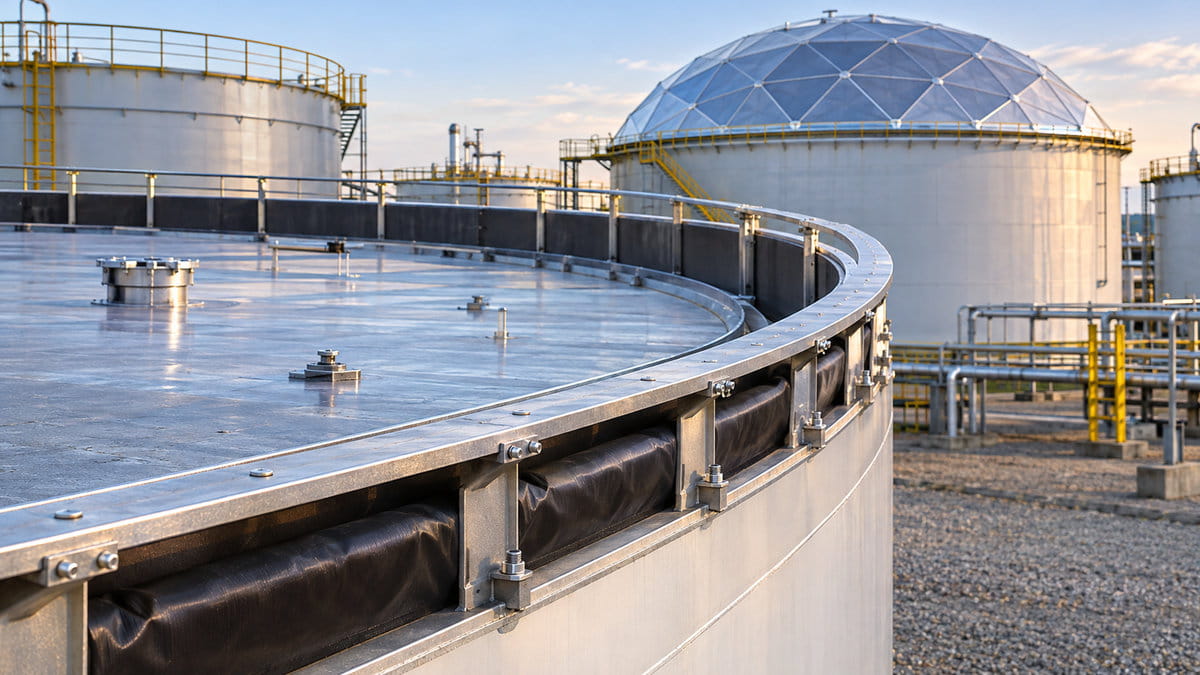
Internal Floating Roof Seals and Aluminum Floating Roofs
An internal floating roof seal performs a similar perimeter-sealing function, but its operating environment differs from that of an external floating roof.
Internal floating roofs operate beneath a fixed roof, which reduces direct exposure to wind and precipitation.
These systems are widely used in storage applications where vapor-loss management is an important engineering consideration.
Sealing Requirements for Internal Floating Roofs
Internal floating roofs may use mechanical shoe seals, resilient-filled arrangements or flexible sealing systems, depending on the roof design and applicable requirements.
For aluminum floating roofs, engineers must consider:
- The floating roof construction and deck geometry.
- Seal attachment and available rim clearance.
- Compatibility between sealing materials and stored liquids.
- Roof movement across the operational filling range.
- Access for inspection and maintenance.
- Requirements associated with deck fittings and penetrations.
Seal design should form part of the overall floating roof engineering process rather than being treated as an isolated component.
Aluminum Floating Roofs and Vapor Control
Aluminum floating roofs are used in industrial tanks because lightweight structures can be incorporated into different storage arrangements.
Both contact and non-contact designs exist.
A properly engineered roof reduces the exposed liquid surface, while its perimeter seals and fitting controls address additional potential vapor-loss paths.
The complete arrangement must be evaluated according to the intended service.
How Aluminum Domes Complement Tank Sealing Systems
Aluminum domes are another technology used in industrial tank applications.
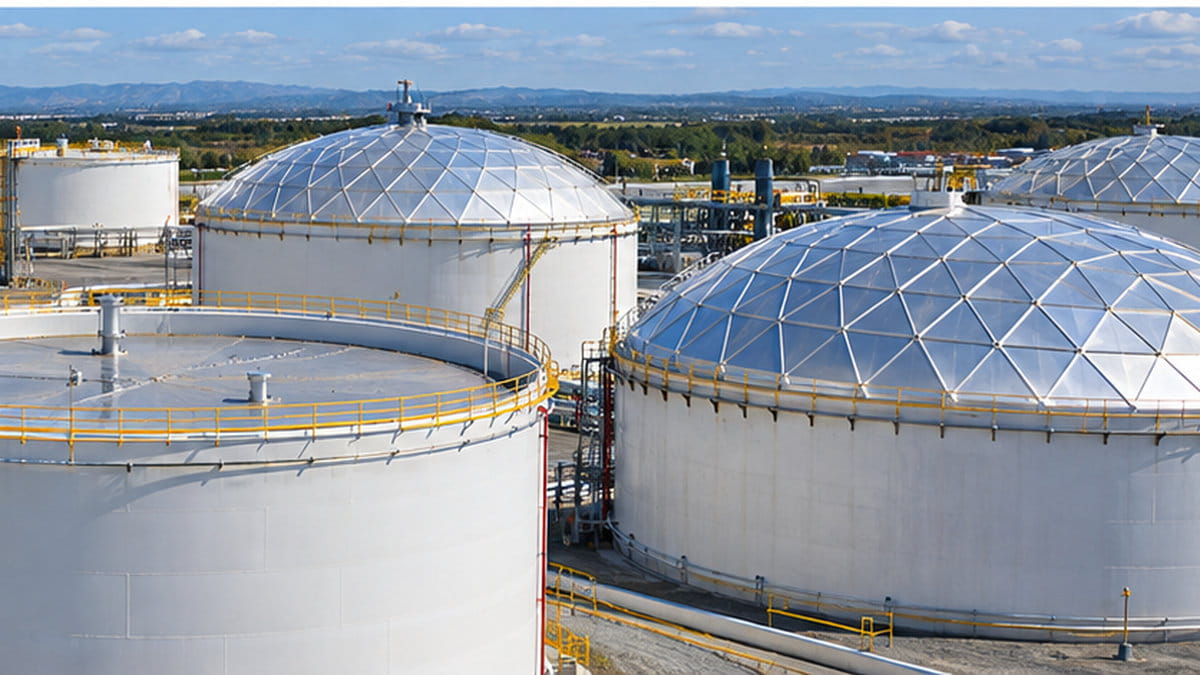
An aluminum geodesic dome is a lightweight, self-supporting roof structure that can be installed over certain storage tanks.
Unlike floating roof seals, which close the gap at the moving roof perimeter, the dome provides a fixed overhead enclosure.
Aluminum Geodesic Domes and Floating Roof Tanks
An aluminum geodesic dome can be considered when converting particular external floating roof arrangements into covered storage configurations.
The dome helps shield the floating deck from direct exposure to wind and precipitation.
According to EPA guidance, wind-induced rim seal losses are especially relevant in external floating roof tanks, while covering the floating roof changes the mechanisms used to estimate those losses.
However, adding an aluminum dome does not eliminate the need to evaluate seals, fittings or ventilation.
Integrated Tank Engineering
For certain projects, engineers may assess aluminum floating roofs, sealing systems and aluminum domes as complementary components.
Floating Roofs
Reduce the exposed liquid surface and help limit vapor generation in storage tanks.
Tank Seals
Limit vapor movement through the annular rim space between the floating roof and tank shell.
Aluminum Domes
Provide a fixed structural enclosure and weather protection for compatible storage systems.
Integrated Engineering
Coordinates complementary technologies according to tank geometry, operating conditions and project requirements.
Their combined suitability depends on technical requirements, compatibility, existing tank conditions and project objectives.
How to Select the Right Tank Sealing System
Choosing industrial tank seals requires a detailed technical assessment.
A sealing arrangement that performs well in one application may not be appropriate for another.
1. Identify the Stored Product
Crude oil, refined petroleum products and specialty chemicals can have different physical and chemical characteristics.
The selection of membranes, elastomers, metallic components and other sealing materials must consider the stored product.
Chemical compatibility is essential to avoid premature deterioration and loss of sealing performance.
2. Evaluate Tank Geometry
The diameter, shell condition and operating clearances influence the choice of sealing technology.
Shell irregularities, previous repairs and variations in the annular gap can affect how the seal maintains contact during roof movement.
For existing tanks, accurate dimensional information is particularly important.
3. Consider the Floating Roof Design
External and internal floating roofs operate under different conditions.
Their construction, attachment arrangements and available space can affect seal selection.
The proposed seal must also work correctly across the expected roof travel range.
4. Review Environmental Requirements
Emission-control requirements vary by country, stored product, installation type and applicable permits.
In the United States, certain storage tanks are subject to federal provisions covering floating roof seals and inspection.
International projects must be assessed against the relevant local regulations and contractual standards.
5. Plan Installation and Maintenance
A suitable seal should allow effective inspection and maintenance over its intended operating life.
Engineers should consider access, replacement procedures, operational constraints and the availability of compatible components.
Some systems may be designed for installation while a tank remains in service, but such work requires project-specific risk assessment and appropriate safety procedures.
Tank Seal Maintenance: What Should Operators Inspect?
The condition of a sealing system can change over time because of mechanical movement, chemical exposure, environmental conditions and general wear.
A preventive maintenance program can help identify problems before they significantly affect performance.
Key Inspection Points
- Seal-to-shell contact: checking for excessive gaps or loss of contact.
- Membrane condition: identifying tears, cracking, deformation or deterioration.
- Metallic components: examining corrosion, distortion and mechanical wear.
- Attachment systems: checking connections and supporting components.
- Roof movement: confirming that the sealing arrangement does not obstruct normal travel.
- Compatibility and degradation: evaluating possible damage caused by stored products or operating conditions.
Inspection methods and intervals must follow applicable regulations, operating procedures and engineering recommendations.
Why Maintenance Matters for VOC Control
A damaged or poorly fitted seal may allow greater vapor movement through the roof perimeter.
This can affect environmental performance and increase evaporation-related losses.
Consequently, tank seal maintenance should be included in broader tank integrity and environmental management programs.
TAC Enviro: Engineering Solutions for Industrial Tank Sealing
Industrial storage projects often require solutions adapted to specific tank dimensions, product characteristics and operational conditions.
TAC Enviro, a Spanish engineering company associated with Tank Aluminum Cover, develops equipment for the petroleum, petrochemical and environmental sectors.
Its product portfolio includes aluminum geodesic domes, floating roof systems and engineered sealing solutions.
TankSeal Primary and Secondary Systems
TAC Enviro's TankSeal range includes solutions for both external and internal floating roof applications.
Among the products described on its website are:
- MS6 mechanical primary seals: developed for crude oil and refined-product tanks.
- TB5 tubular primary seals: using liquid-filled flexible elements.
- PT1 pantograph seals: designed to maintain contact with the tank shell.
- Compression plate secondary seals: including CPL5, CPP, CPI and CPU configurations.
- DL5 double compression plate systems.
- Mini-Shoe (MSH), Delta (DLT), Graver (GVR) and Wiper (WPR): configurations for different internal floating roof applications.
These systems illustrate the importance of selecting sealing technology according to tank configuration and operational requirements.
TAC Enviro describes API 650 alignment for selected designs; final conformity must always be assessed against the applicable standard, project specifications and supporting technical documentation.
Complementary Tank Technologies
In addition to sealing systems, TAC Enviro develops products such as TankDome aluminum geodesic domes and TankPontoon and TankContact floating roof solutions.
These technologies address different aspects of tank protection, product conservation and operational performance.
Tank Seals, Environmental Performance and Long-Term Reliability
Effective tank sealing is one part of a broader strategy for managing evaporation, maintaining storage efficiency and supporting environmental compliance.
The most appropriate solution depends on engineering design, stored product properties, tank geometry, installation requirements and ongoing maintenance.
Primary and secondary seals, compression plate systems and internal floating roof seals each address particular technical needs. Aluminum floating roofs and geodesic domes may complement these technologies when an integrated storage solution is required.
For companies evaluating tank seals, the priority should be a technically justified selection supported by material compatibility, applicable standards and a realistic maintenance strategy.
TAC Enviro provides information on its TankSeal range and complementary tank technologies for engineering teams assessing industrial storage projects.
Explore TAC Enviro's TankSeal Solutions
Discover TAC Enviro's range of primary and secondary tank sealing systems for industrial floating roof storage tanks.
Explore mechanical shoe, tubular, pantograph and compression plate configurations developed for different storage applications.
Explore TAC Enviro TankSeal SystemsFrequently Asked Questions About Tank Seals
What are tank seals used for?
Tank seals close gaps in industrial storage tank systems. In floating roof tanks, rim seals limit vapor escape through the annular space between the floating roof perimeter and the tank shell.
What is the difference between primary and secondary tank seals?
A primary seal forms the main barrier between the floating roof and the tank wall. A secondary seal provides an additional barrier above it, helping to further limit vapor movement.
Which tank seals are used for external floating roofs?
External floating roof systems may use mechanical shoe seals, resilient-filled seals and secondary compression plate or wiper arrangements. The configuration depends on engineering and regulatory requirements.
What is a compression plate seal?
A compression plate seal uses metallic components and flexible sealing materials to maintain contact with the tank wall and limit vapor passage. It is commonly considered for secondary sealing applications.
Can tank seals reduce VOC emissions?
Properly designed and maintained seals can reduce evaporation-related vapor losses from the rim space. Actual performance depends on seal design, tank operating conditions and the condition of the complete storage system.
Are tank seals necessary with an aluminum geodesic dome?
A dome and a floating roof seal serve different purposes. A dome provides an overhead enclosure, while the seal closes the gap around the floating roof. The need for each component depends on the complete tank design.
How often should floating roof seals be inspected?
Inspection frequency depends on the applicable regulations, tank configuration, operating conditions and facility maintenance program. Operators should follow the relevant standards and site-specific inspection requirements.
Technical References
Further information about emissions from industrial storage tanks is available in the US EPA AP-42 guidance on organic liquid storage tanks.
For tank design and inspection standards, consult the publications and guidance issued by the American Petroleum Institute.
Technical note: This article provides general engineering information and should not be treated as a design specification or compliance determination. Seal selection, installation, inspection and maintenance must be evaluated by qualified professionals against applicable standards, site conditions and safety procedures.


